Why Oven Preheating Matters—and When It Doesn't
Preheating matters when a recipe depends on a known starting temperature for timing, expansion, crust formation or browning. It is not universally necessary: some foods can cook successfully from a cold oven. The key question is whether the recipe was designed and tested for a hot or cold start.
Key takeaways
- Preheating gives a recipe a more predictable thermal starting point; it does more than simply warm the air inside the oven.
- Foods that need fast expansion, crisping or crust development are generally more sensitive to a cold start.
- A cold oven can work for some cakes, muffins, cookies, quick breads, pies and long-cooking dishes—but that does not make it interchangeable with preheating in every recipe.
- The preheat signal does not mean exactly the same thing on every oven; some models signal at the set temperature while others signal when the oven is considered hot enough to begin cooking.
- When a tested recipe tells you to preheat, follow that instruction the first time. Experiment only after you understand what changing the starting condition may affect.
Preheating an oven is often treated as one of cooking's unquestionable rules: switch the oven on, wait for the beep, then put the food in.
That rule is useful—but it is not universal.
What preheating really does is give a recipe a known thermal starting condition. That can be crucial for pizza, pastry or biscuits and much less important for a forgiving casserole that will spend an hour in the oven. The useful question, therefore, is not simply “Do I have to preheat the oven?” It is “What does this particular recipe need to happen when the food first goes in?”
What does preheating actually do?
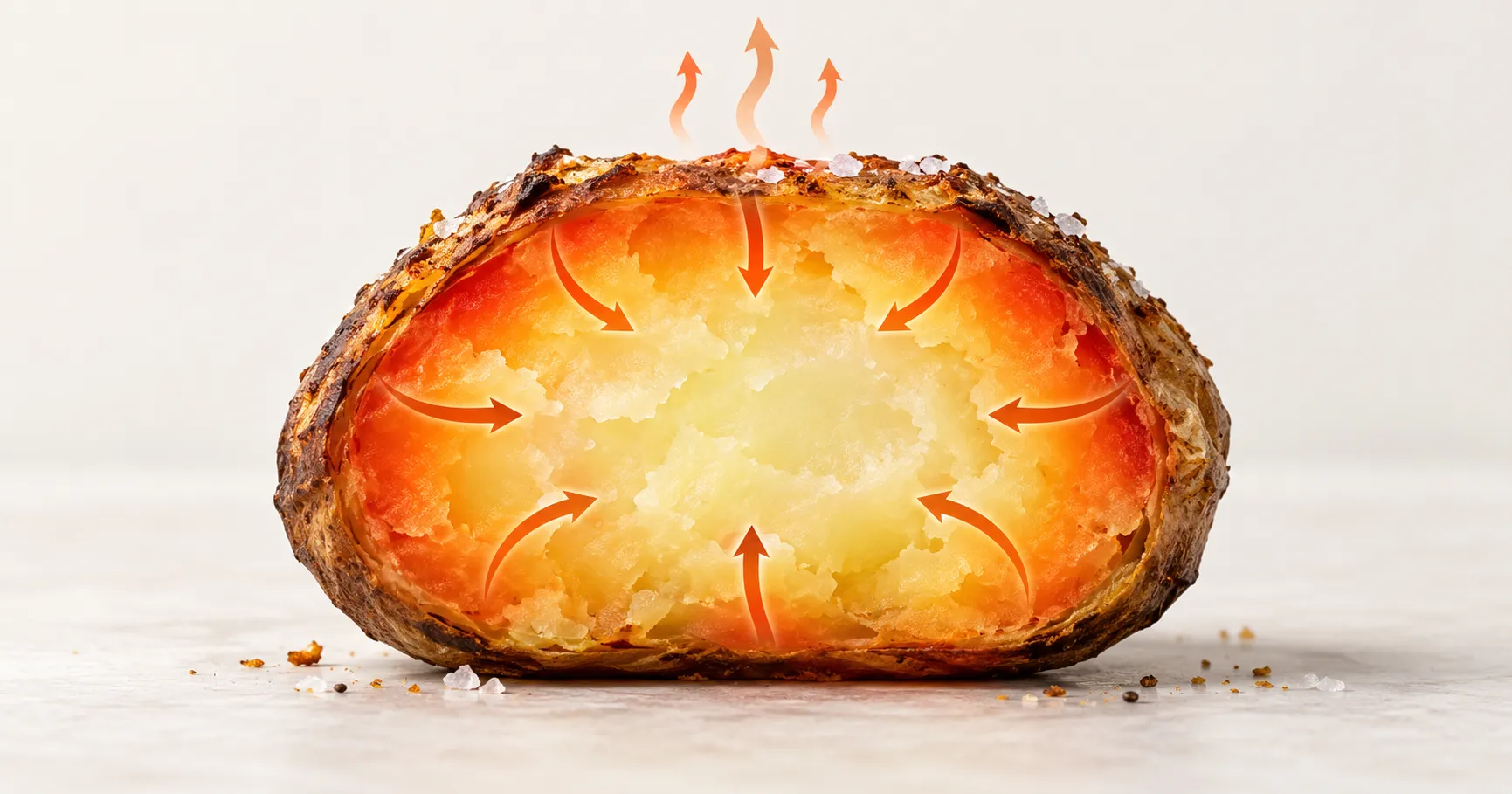
Preheating makes the oven environment more predictable before cooking begins. It heats not only the air but also the oven cavity and, to varying degrees, the racks, walls and anything else left inside.
That distinction matters because an oven does not cook food through hot air alone.
Heat can reach food by convection, radiation and conduction. OpenStax's explanation of the three basic mechanisms describes convection as heat transferred through moving fluid such as air, radiation as energy transferred by electromagnetic waves, and conduction as heat transfer through matter in contact. Read OpenStax on the mechanisms of heat transfer
Inside an oven, those mechanisms overlap. Hot air transfers heat to the food, hot interior surfaces radiate energy toward it, and a metal pan conducts heat into whatever touches it. Baking-oven research likewise treats convection and radiation together when measuring how heat reaches the surface of food. Read the baking-oven heat-transfer study
So a display reading 200°C does not mean that every object and every point inside the oven is simultaneously sitting at exactly 200°C. What matters to the food is the whole thermal environment, not one temperature number.
Why can the starting temperature change a recipe?
A hot start can change what happens during the first few minutes of cooking. For some foods, those minutes are disproportionately important.
Several processes may be happening at once:
- leavening gases expand;
- water begins turning to steam;
- butter or other fats soften and melt;
- proteins and starches begin setting the structure;
- moisture leaves the surface;
- the exterior begins browning, through reactions such as the Maillard reaction;
- dough or batter spreads, rises or firms up.
Not every process matters equally in every dish. That is exactly why a blanket rule about preheating is unhelpful.
Consider puff pastry. Its structure depends partly on water becoming steam while layers of fat and dough behave in a controlled way. A slow warm-up changes the sequence of events compared with placing the pastry into an already-hot oven.
A casserole is different. It may spend 45 or 60 minutes gradually heating through, with no requirement for dramatic early expansion. The first five minutes can therefore matter much less.
Preheating matters most when the beginning of cooking is part of the recipe's engineering.
Which foods usually benefit most from a preheated oven?
Foods that depend on a fast early transfer of heat are generally the strongest candidates for preheating.
| Food | Why the hot start can matter |
|---|---|
| Pizza | Helps the dough begin cooking quickly and supports rapid crust development, especially when using a hot stone or steel. |
| Crusty bread | A hot oven supports the early expansion and crust-forming conditions expected by many bread formulas. |
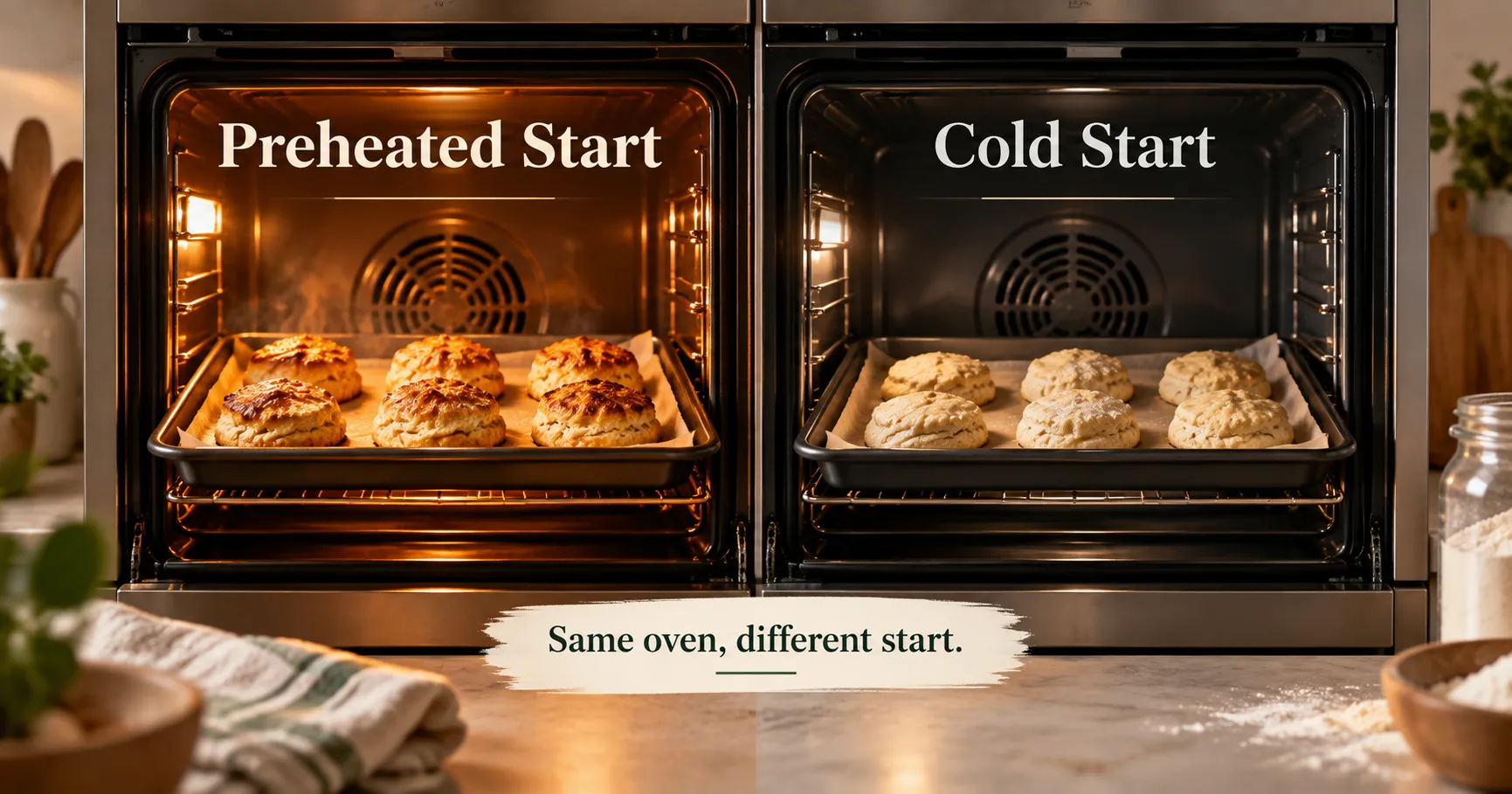
| Scones and American-style biscuits | Their rise and texture can be sensitive to how quickly the dough heats. |
| Puff pastry | Rapid heating helps generate steam and establish the layered structure before the pastry simply softens. |
| Some cookies | Starting temperature can change the balance between spreading and setting. |
| Foods meant to crisp quickly | A hot environment can encourage faster surface heating and moisture loss. |
This does not mean every cookie, every bread or every pastry fails from a cold start. Recipe composition, size, pan, oven mode and intended texture all matter.
That caveat turns out to be more than theoretical.
Can you ever start with a cold oven?
Yes. Some recipes can work surprisingly well without conventional preheating.
King Arthur Baking tested this directly rather than treating preheating as an automatic rule. In a series of 24 practical tests conducted in two ovens, PJ Hamel reported successful cold starts with a range of cakes, drop cookies, muffins, quick breads and fruit pies. Muffins rose higher, and drop cookies spread more slowly and evenly. Read King Arthur Baking's cold-start tests
But the same testing also reveals the limit of the idea. Scones and American-style biscuits were poorer candidates: King Arthur reports that from a cold start they don't rise as high and come out drier. It also advises that crusty breads made from lean doughs should bake hot and fast in a preheated oven—with one notable exception, crusty bread baked in a Dutch oven, which gave excellent results from a cold start.
That is useful test-kitchen evidence, not a law of baking physics. It tells us that “always preheat” has exceptions; it does not tell us that any recipe can be converted to a cold start without consequences.
Why do the recipe instructions matter more than a universal rule?
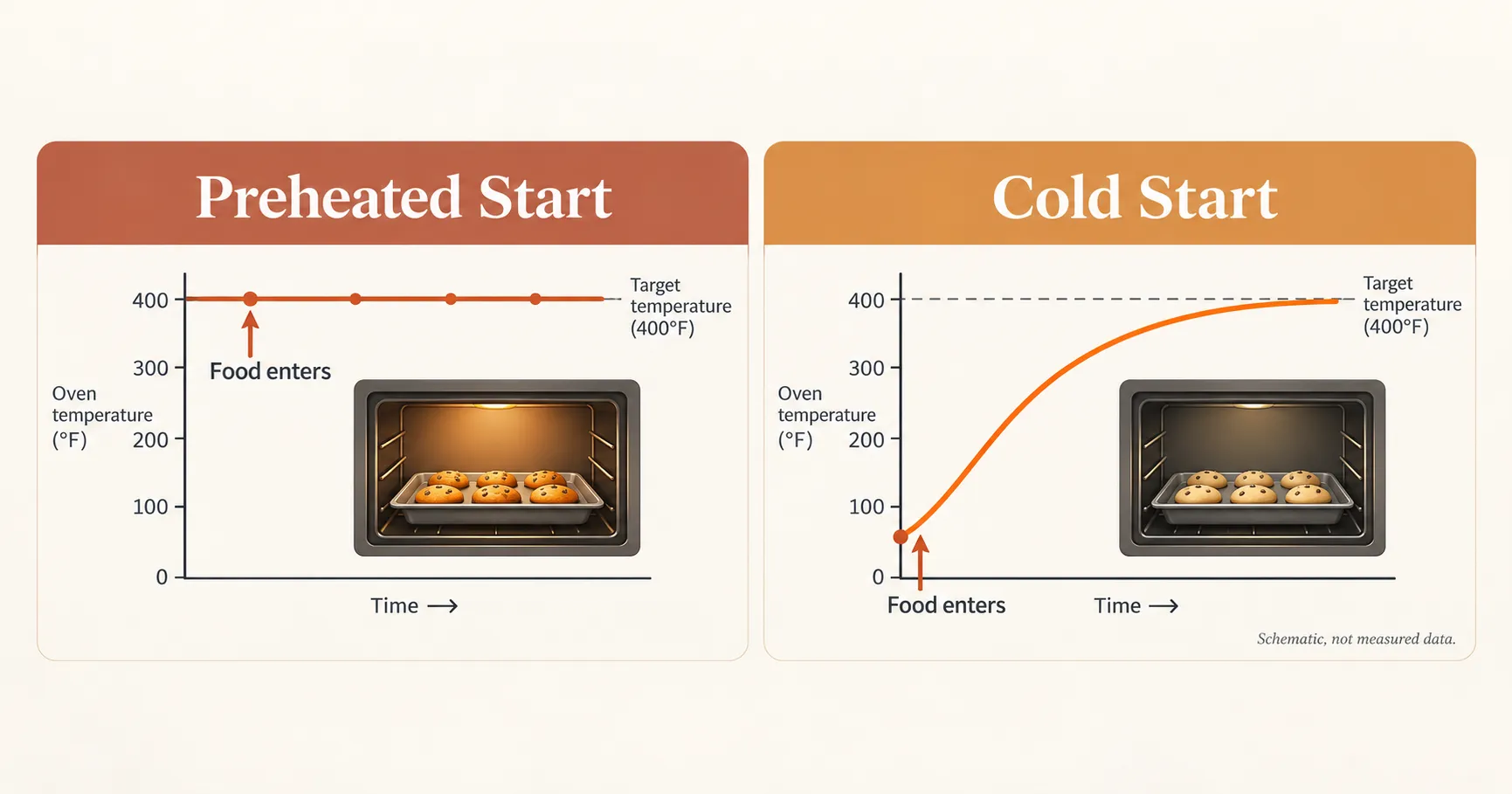
Because a well-tested recipe includes its starting temperature as part of the method.
If the developer tested a cake by putting it into a fully preheated oven and baking it for 28 minutes, the stated time, expected rise and target colour all reflect that condition.
Starting the same cake in a cold oven changes the experiment.
The batter may spend longer at lower temperatures. Fat may melt at a different point relative to the structure setting. The surface may dry and colour differently. And “28 minutes” no longer represents the same thermal history.
The reverse is also true. If a recipe was intentionally developed for a cold oven, preheating first can change its result.
This is the most useful rule to remember:
Does the oven beep mean everything inside is fully heated?
Not necessarily—and there is no universal extra waiting time that applies to every oven.
Even the meaning of the preheat signal varies by appliance. GE Appliances, for example, explains that some models signal when the selected temperature has been reached, while some newer models signal when the oven is considered hot enough for food even though the cavity has not yet reached the set temperature. Read GE Appliances' guidance on oven preheat signals
That is a useful reason to be sceptical of advice such as “always wait another 20 minutes after the beep.” It may help with a particular oven or a temperature-sensitive baking setup, but it is not a universal rule.
For normal cooking, follow the manufacturer's guidance and learn how your own oven behaves. For especially sensitive baking—or when results are repeatedly inconsistent—an independent oven thermometer or other temperature measurement can help diagnose whether actual oven behaviour matches the setting.
If you keep a heavy baking stone or steel inside, remember that it adds substantial thermal mass. Stored heat matters at the other end of cooking too, when food keeps cooking after it leaves the oven. The oven may be ready for ordinary baking before that accessory has absorbed as much energy as you want for pizza or bread.
What changes in a convection oven?
Moving the air changes the rate and distribution of heat transfer at the food's surface.
A convection oven uses a fan to circulate hot air. That forced air movement can increase heat transfer and influence cooking speed, browning and surface moisture loss. Experimental baking-oven research found higher calculated surface heat-transfer coefficients with the fan on than in a static oven, across the 70–220°C range it tested.
King Arthur's practical convection guidance similarly reports more even browning and notes that things bake more quickly with the fan on—which is why recipes written for conventional baking are often baked about 25°F (roughly 15°C) cooler in convection mode. Read King Arthur Baking on convection oven baking
For the physics behind this, see how moving air changes heat transfer in an oven, including the difference between natural and forced convection.
Preheating still matters in convection mode when the recipe needs a known hot start. Convection changes the heat-transfer conditions; it does not make starting temperature irrelevant.
When can preheating be unnecessary or wasteful?
Skipping a separate preheat can make sense when the dish is forgiving or the recipe was specifically designed around a cold start.
Possible examples include:
- some long, slow braises;
- some casseroles and baked dishes with generous cooking times;
- cakes, muffins, cookies or breads specifically tested with a cold start;
- certain reheating jobs where precise timing and immediate crisping are not important.
The important words are “some” and “specifically tested.”
Do not convert these into new universal rules. A casserole with a delicate topping may respond differently from a covered one. Reheating pizza for a crisp base is not the same problem as warming a dense baked pasta.
Skipping preheating is useful only when the quality you want does not depend on the hot start—or when the method deliberately takes the warming period into account.
So, should you preheat the oven?
Usually, if the recipe tells you to. But preheating is a technique, not a ritual.
A practical way to decide is to ask three questions:
- Does the recipe explicitly say to preheat?
Follow it, particularly the first time you make the dish. - Does the food depend on fast rise, expansion, crisping or crust development?
A properly heated oven is more likely to matter. - Was the recipe deliberately developed for a cold start?
If yes, use the cold start rather than “correcting” it by preheating.
The better your recipes are written, the less guesswork you should need—and reading the whole recipe before you start tells you which kind of start it expects.
Preheating does not automatically make food better, and skipping it does not automatically save a recipe—or ruin one. What matters is whether the starting thermal condition matches the process the recipe was designed around.
That is a more useful rule than “always preheat.”
Sources
- 1.6 Mechanisms of Heat Transfer
General university-physics reference explaining conduction, convection and radiation. It supports the underlying heat-transfer principles, but is not specifically a study of domestic ovens.
- Convection and radiation combined surface heat transfer coefficient in baking ovens
Experimental study measuring combined convection and radiation surface heat-transfer coefficients in a convective oven at 70–220°C, with and without the fan. Its measured conditions should not be treated as representative of every domestic oven.
- Believe it or not, you don't always have to preheat your oven
Practical test-kitchen evidence from 24 tests run in two ovens. Useful for showing that some baked goods can succeed with a cold start, but it is not a controlled scientific study and should not be generalized to all recipes or ovens.
- Range & Wall Oven - Preheat
Manufacturer guidance explaining that preheat indicators can behave differently across oven models. The advice is specific to GE ranges and wall ovens and should not be assumed to describe every oven brand or model.
- Convection oven baking: Why this baker is a fan
Practical baking guidance about convection mode, browning and cooking rate. It reflects test-kitchen and baker experience rather than a controlled scientific experiment, so results can vary with oven design and fan strength.