Why Food Keeps Cooking After You Take It Off the Heat
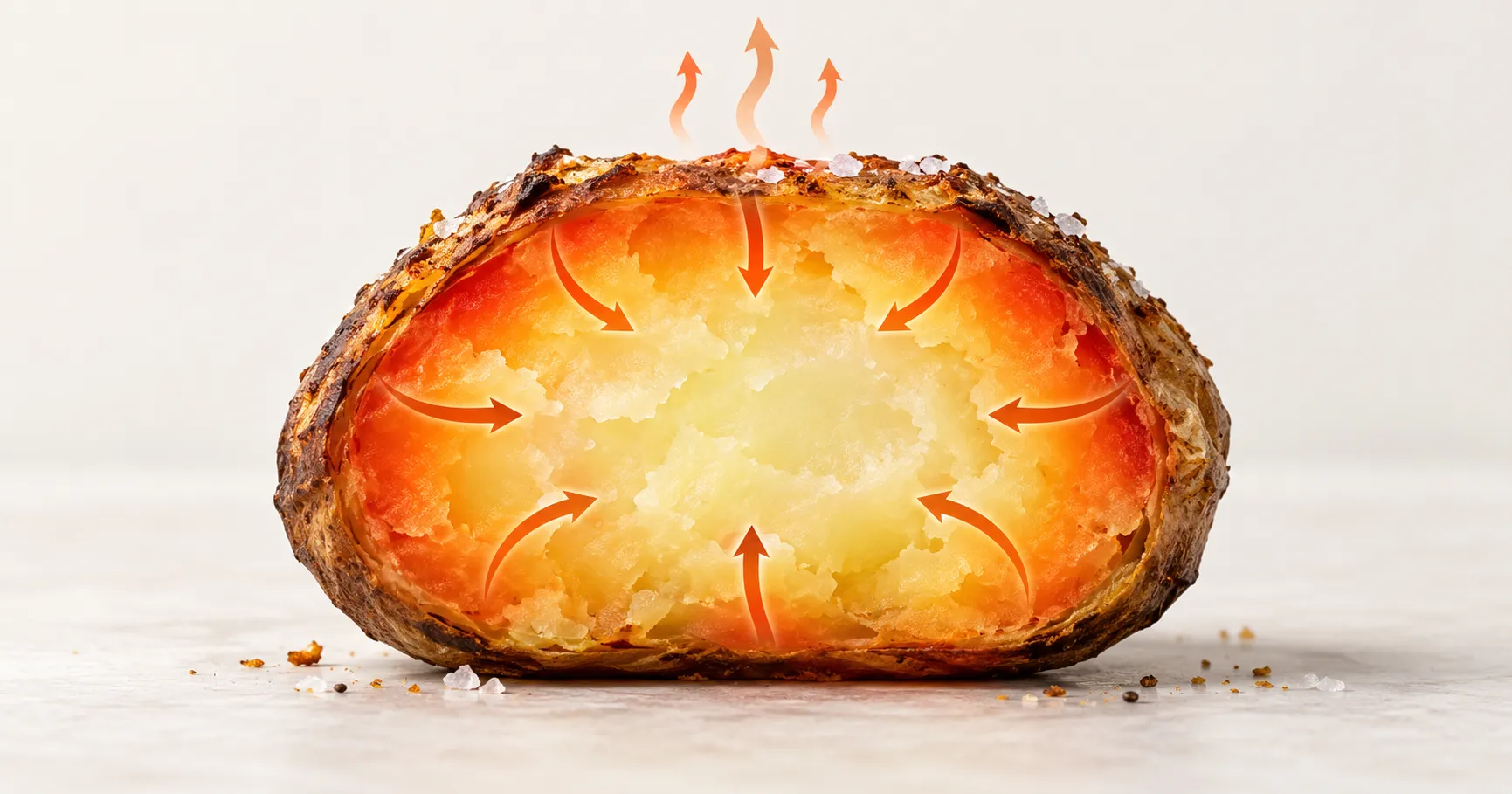
Food can keep cooking after it leaves the heat because its outer layers are often hotter than its centre. Heat stored near the surface continues moving inward even as the food begins cooling overall. This is called carryover cooking, and it varies with the food’s size, shape, thickness and cooking temperature.
Key takeaways
- Carryover cooking happens because heat continues moving from hotter parts of food toward cooler parts after the external heat source is removed.
- A food’s surface can be cooling at the same time that its centre is still getting hotter.
- Larger, thicker foods and foods cooked at high temperatures often show more noticeable carryover than small or thin foods.
- There is no universal rule that every food rises by 5°C, 10°F or any other fixed amount after cooking.
- Resting and carryover cooking are related but are not the same thing: resting is a period of time, while carryover cooking describes continued heat movement.
- Food-safety decisions should follow official temperature guidance, not an assumed amount of carryover cooking.
What is carryover cooking?
Carryover cooking is the continued movement of heat inside food after it has been removed from its main heat source.
While food is in an oven, pan, grill or other cooking environment, its outer regions usually heat first—the reason food usually cooks from the outside inward. Heat then moves from those hotter regions toward cooler regions inside the food.
Removing the food from the heat stops the main external energy input, but it does not instantly make every part of the food the same temperature. Heat already stored in the hotter outer layers can continue moving toward the cooler centre.
As the OpenStax explanation of heat transfer describes, heat flows when a temperature difference exists. Within a solid or semi-solid food, conduction therefore continues as long as neighbouring regions remain at different temperatures.
The important part is that two processes can happen at once:
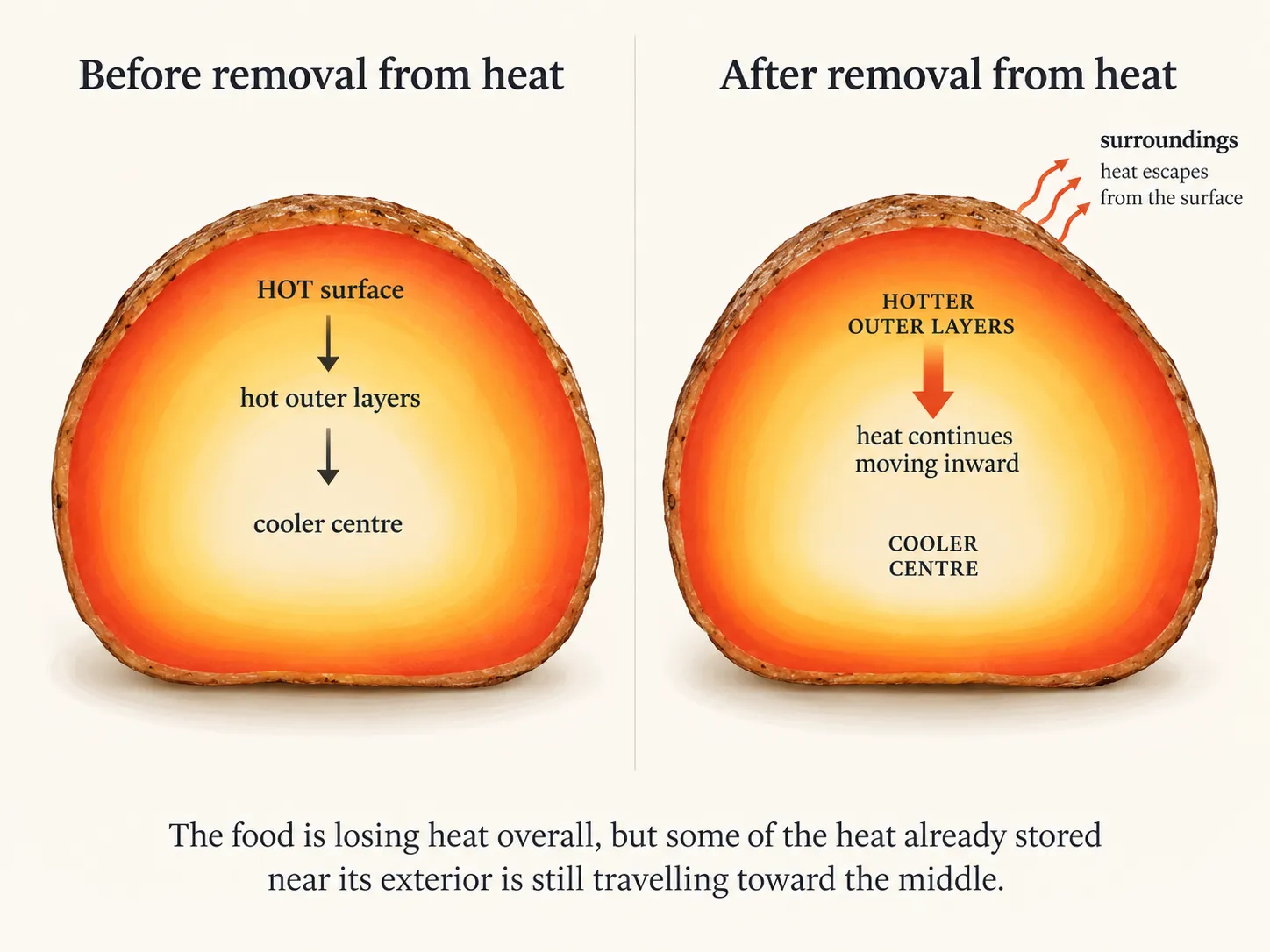
Heat escapes from the surface into the surroundings while heat stored in the outer layers keeps moving toward the centre—so the food can be cooling overall while its middle is still warming.
Why can the centre get hotter while the food is cooling?
Because the entire food does not have one temperature.
A thick roast, baked potato or other large piece of food can contain a significant temperature gradient. Its outside may be very hot, the layer beneath it somewhat cooler, and the deepest part cooler still.
Once the food comes out of the oven, the surface immediately starts losing heat to the surrounding air and other nearby surfaces. Evaporation can also remove energy from a moist surface.
At the same time, however, heat inside the food continues moving down its own temperature gradient—from the hotter outer regions toward the cooler interior.
That means a thermometer placed near the thermal centre can briefly show the temperature rising, even though the food as a whole is already losing energy.
Eventually, the internal temperature differences become smaller. Heat flowing into the centre no longer exceeds heat being lost from the food, the centre reaches its peak temperature and then begins to cool as well.
That apparently contradictory behaviour—a cooling food with a warming centre—is the key to understanding carryover cooking.
Which foods show more carryover cooking?
Carryover is generally more noticeable when a food can store substantial heat and has a meaningful temperature difference between its exterior and centre.
Several factors matter.
| Factor | Why it can increase carryover |
|---|---|
| Larger or thicker food | More distance separates the hot exterior from the cooler centre, and a larger piece can contain more stored thermal energy. |
| Compact shape | Less surface area relative to volume can slow the loss of heat to the surrounding air. |
| Large surface-to-centre temperature difference | A stronger temperature gradient creates more potential for heat to continue moving inward. |
| High-temperature cooking | The exterior can become much hotter than the centre, creating a larger gradient when the food is removed. |
| Insulation or covering | Slowing heat loss from the exterior can change how much stored heat remains available to move inward. |
This is why a large roast may behave very differently from a thin slice of food, even if both have the same centre temperature at the instant they leave the heat.
Shape matters as well as weight. A broad, thin item has relatively more surface area through which it can lose heat, while a thick, compact piece can retain heat differently.
ThermoWorks' practical testing illustrates the point. In one experiment, a 150 g pork chop removed at 140°F (60°C) rose about 4.9°F (2.7°C) after cooking in a 300°F (150°C) oven, compared with about 11.5°F (6.4°C) when cooked in a 425°F (220°C) oven. Read ThermoWorks' carryover cooking tests Those figures are observations from that particular test, not universal numbers for pork or other foods.
Why does the cooking temperature matter?
Higher-temperature cooking can create a larger difference between a food's exterior and its centre, which can produce more carryover after the food is removed.
Think of two otherwise similar pieces of food.
With high-temperature roasting, the exterior may become very hot before the centre reaches its target temperature:
Very hot exterior
↓
large temperature gradient
↓
greater potential for continued inward heat transfer
With gentler cooking, the temperature difference between the exterior and centre may be smaller:
Moderately hotter exterior
↓
smaller temperature gradient
↓
potentially less carryover
ThermoWorks observed this pattern in its kitchen tests: in every case it reported, meat cooked at the higher oven temperature showed more carryover than the same cut cooked at the lower temperature.
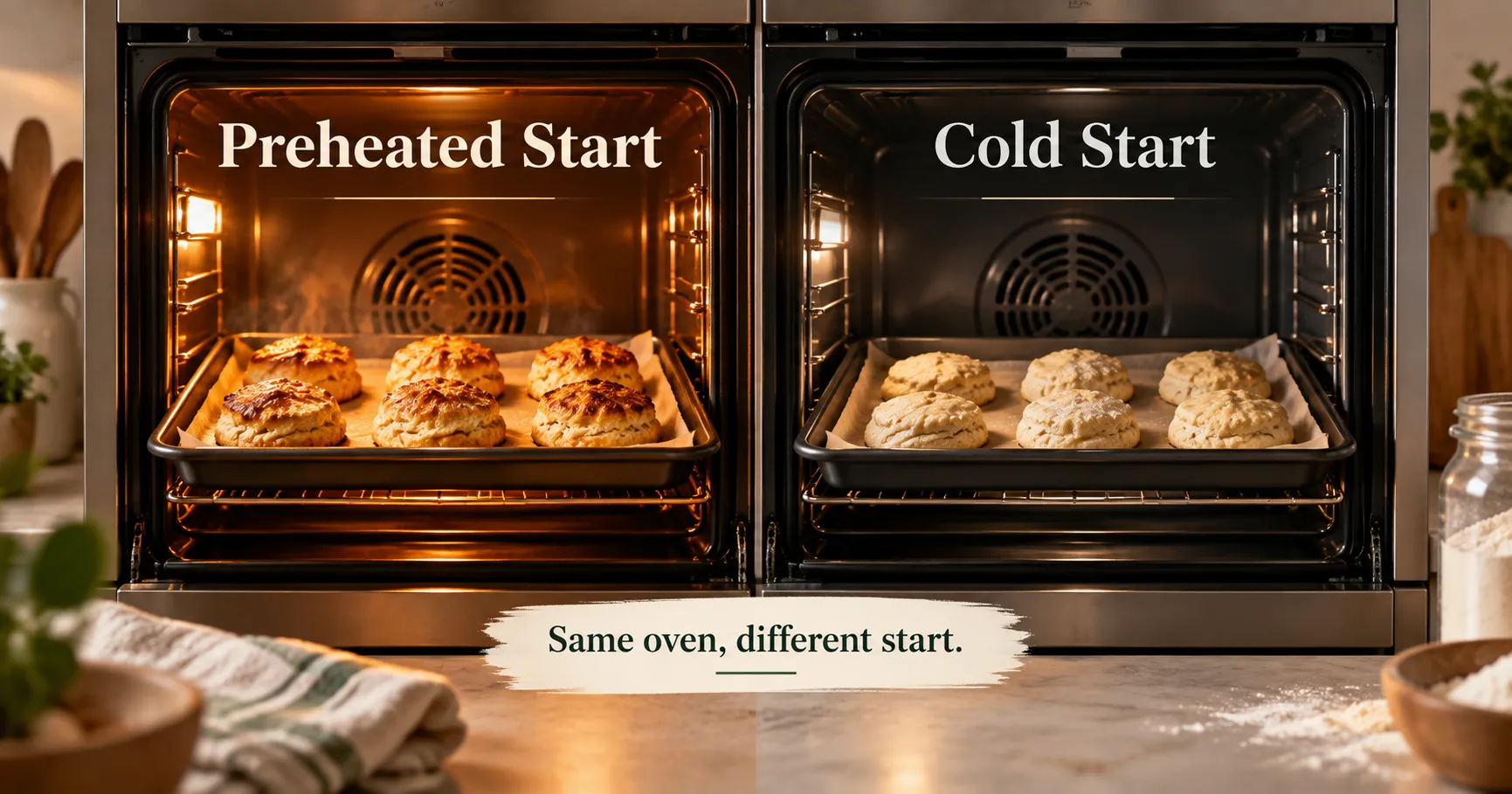
This does not mean that oven temperature alone predicts carryover. Thickness, shape, moisture, cooking method, covering, surrounding temperature and the food itself can all affect the result. The oven's starting condition plays a part as well, which is why preheating changes some recipes and not others.
Is carryover cooking the same as resting?
No. Resting describes a period of time; carryover cooking describes a thermal process that may happen during that time.
If a roast sits for ten minutes after leaving the oven, those ten minutes are its resting period. If heat is continuing to travel from hotter outer regions toward its cooler centre during those ten minutes, that temperature change is carryover cooking.
The two therefore often overlap, but the terms are not interchangeable.
Resting instructions can also exist for reasons specific to a particular food or cooking method. It is too simplistic to say that the only purpose of resting food is to allow carryover cooking.
Does every food rise by 5°C or 10°F after cooking?
No. There is no reliable universal carryover number.
Practical measurements demonstrate just how much the result can vary. In ThermoWorks' experiment, different foods and cooking temperatures produced substantially different rises after removal from the oven.
For everyday cooking, the useful lesson is not to memorise one number. It is to understand why carryover happens and, when temperature matters, measure the food rather than assume its behaviour—the same reason it pays to use doneness cues rather than cooking time alone.
What does carryover cooking mean for food safety?
Carryover cooking should not be used as a general excuse to remove high-risk food below an applicable safe cooking temperature.
Food-safety requirements differ by food and by jurisdiction, so follow the official guidance that applies where you live.
For example, current U.S. Department of Agriculture guidance specifies a minimum internal temperature of 145°F (62.8°C) followed by at least a three-minute rest for whole cuts of beef, pork, veal and lamb. Poultry has different guidance: USDA specifies 165°F (73.9°C) for poultry. See the USDA safe minimum internal temperature chart
Importantly, the USDA chart describes these as temperatures to reach before removing the food from the heat source where specified; it does not tell home cooks to assume that an arbitrary amount of carryover will make an under-temperature food safe.
The safest way to treat carryover is as part of understanding how heat behaves—not as a substitute for food-safety instructions.
Does carryover cooking happen in a microwave?
Yes. Standing time after microwave cooking can be an important part of the heating process.
Microwaves do not necessarily heat every part of a food equally. The USDA notes that in thicker foods, microwave energy may not reach the centre directly, so heat from warmer outer regions continues moving inward by conduction. Read USDA guidance on cooking with microwave ovens
The agency also specifically tells consumers to observe microwave standing time, noting that cooking continues after microwave heating stops and that this effect can last longer in dense foods such as large roasts than in smaller or less-dense foods.
That is carryover cooking in a particularly practical form.
If microwave instructions specify a standing period, therefore, it should be treated as part of the cooking directions rather than optional waiting time.
How can you observe carryover cooking yourself?
You can see the effect directly without experimenting with meat or another high-risk food. A large baked potato makes a simple demonstration.
- Choose a large potato of fairly even shape.
- Insert an oven-safe probe thermometer close to its centre, following the thermometer manufacturer's instructions.
- Bake the potato normally.
- When you remove it from the oven, note the centre temperature immediately.
- Leave the probe in place and record the temperature about once per minute for several minutes.
- Watch for a period in which the centre temperature continues to rise before reaching a peak.
- Continue observing and you should eventually see the temperature begin to fall.
The exact result will depend on the potato, the oven temperature, how long it was cooked and how quickly heat escapes after removal.
The point of the experiment is not to produce a particular number. It is to make the hidden temperature gradient visible.
You are watching heat that was already inside the potato redistribute itself.
The useful way to think about carryover cooking
Carryover cooking makes more sense when you stop thinking of a cooked food as having one temperature.
Instead, imagine a temperature map running from its surface to its thermal centre.
While the food is heating, energy creates and maintains differences across that map. When you switch off the heat or take the food out of the oven, the external energy supply may stop immediately—but the temperature differences inside the food do not.
Heat therefore keeps moving.
Some travels outward and is lost to the surroundings. Some travels inward toward cooler regions. For a short period, that inward flow can be strong enough for the centre to continue getting hotter.
Only after those gradients diminish does the whole food settle into straightforward cooling.
That is carryover cooking: not mysterious extra heat appearing after cooking, but heat that was already in the food continuing to move.
Sources
- 1.6 Mechanisms of Heat Transfer
General physics textbook source used to support the explanation of conduction, temperature gradients and heat flowing from hotter regions toward cooler regions. It is not specifically about carryover cooking.
- Safe Minimum Internal Temperature Chart
U.S.-specific food-safety guidance. Used for minimum internal temperatures and required rest periods; readers in other countries should follow the official guidance for their jurisdiction. The page specifies, for example, 145°F (62.8°C) plus a three-minute rest for whole cuts of beef, pork, veal and lamb, and 165°F (73.9°C) for poultry.
- Cooking with Microwave Ovens
U.S.-specific consumer food-safety guidance. Used to support the discussion of microwave standing time, uneven heating and continued cooking after microwave heating stops. USDA describes this post-heating period as carryover cooking, resting time or standing time.
- Carryover Cooking: The Hot Science Behind Your Food's Finish
Practical kitchen temperature testing by a thermometer manufacturer, not an academic study. Useful for illustrating how carryover varies with cooking temperature, food mass, shape and type; its measured temperature rises should not be treated as universal values. The page is dated 9 October 2025; its reader comments go back to 2019.