What Is the Maillard Reaction and Why Does It Make Food Taste Better?
The Maillard reaction is a complex network of chemical reactions mainly between amino-containing compounds and reducing sugars. During cooking and food processing, it can produce brown pigments and many aroma and flavour compounds. Its rate depends on factors including temperature, time, moisture, pH and the composition of the food.
Key takeaways
- The Maillard reaction is not one reaction but a network of chemical reactions involving amino compounds and reducing sugars.
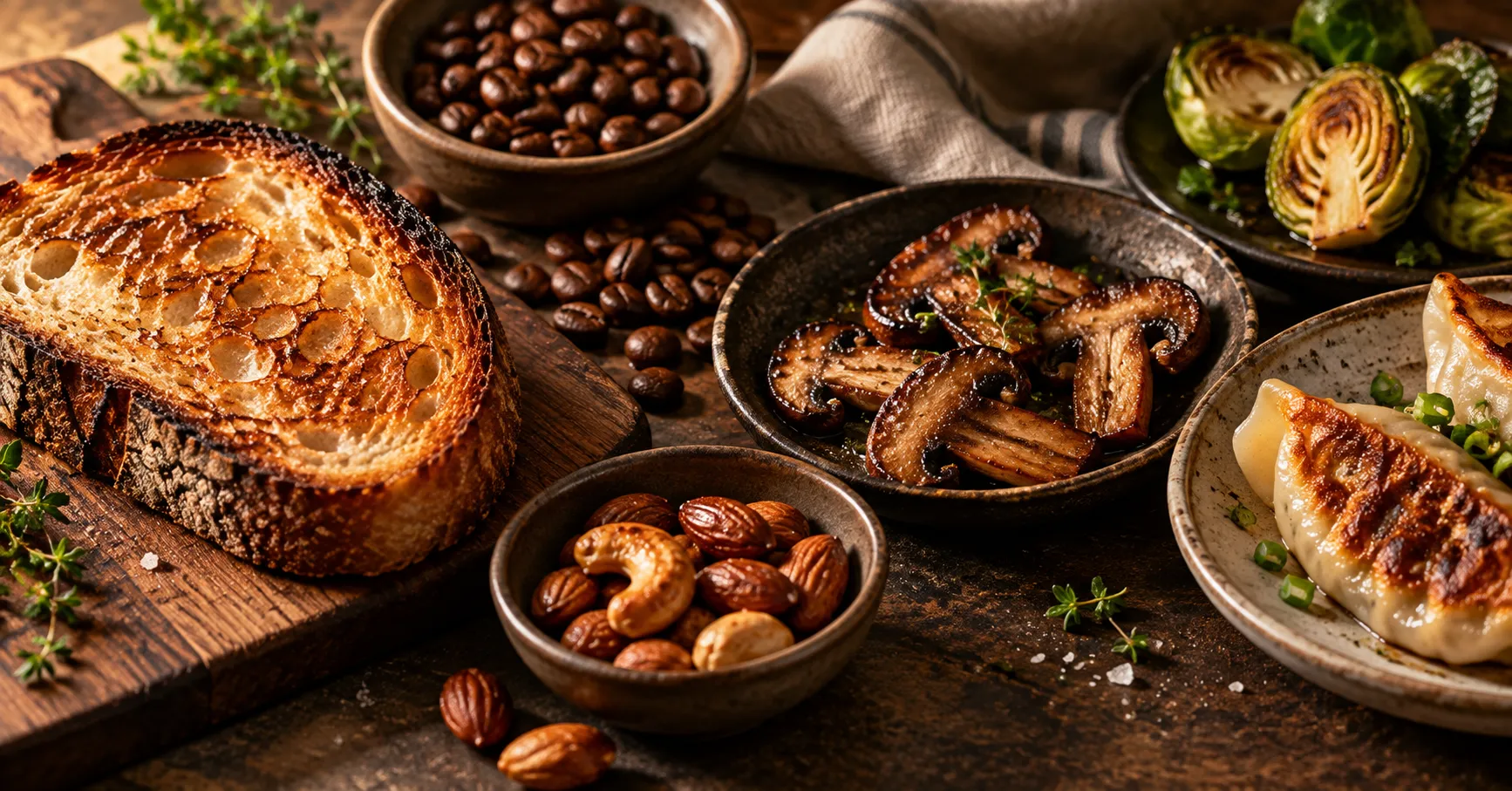
- It contributes to the browned colour and complex aromas of foods such as bread, coffee, meat, nuts and baked foods.
- Browning is influenced by temperature, time, water activity, pH and the specific sugars and amino compounds present.
- There is no universal temperature at which the Maillard reaction suddenly begins.
- Maillard browning and caramelisation are different processes, even though both can create brown colours and cooked flavours.
- More browning is not automatically better: excessive heating can produce bitterness, nutrient changes and undesirable processing compounds.
A slice of bread becoming toast, coffee beans developing their roasted aroma and the surface of food turning deeply golden in a hot pan may look like simple "browning". Chemically, however, some of the most important changes happening in those foods belong to a much larger process known as the Maillard reaction.
The Maillard reaction is best understood not as one neat chemical event, but as a network of reactions. It typically begins when reactive carbonyl groups—particularly those from reducing sugars—interact with amino-containing compounds from amino acids, peptides or proteins. Those early reactions can lead through many intermediate pathways to a large and varied collection of compounds affecting colour, aroma and flavour.
That complexity matters. There is no single "Maillard flavour", just as there is no single molecule responsible for everything we recognise as roasted, toasted or browned food.
Scientific reviews identify temperature, time, pH, water activity and the particular reactants present as important variables controlling the reaction. Read the 2025 review of Maillard mechanisms and influencing parameters in Foods
What exactly is the Maillard reaction?
At its simplest, the process can be pictured like this:
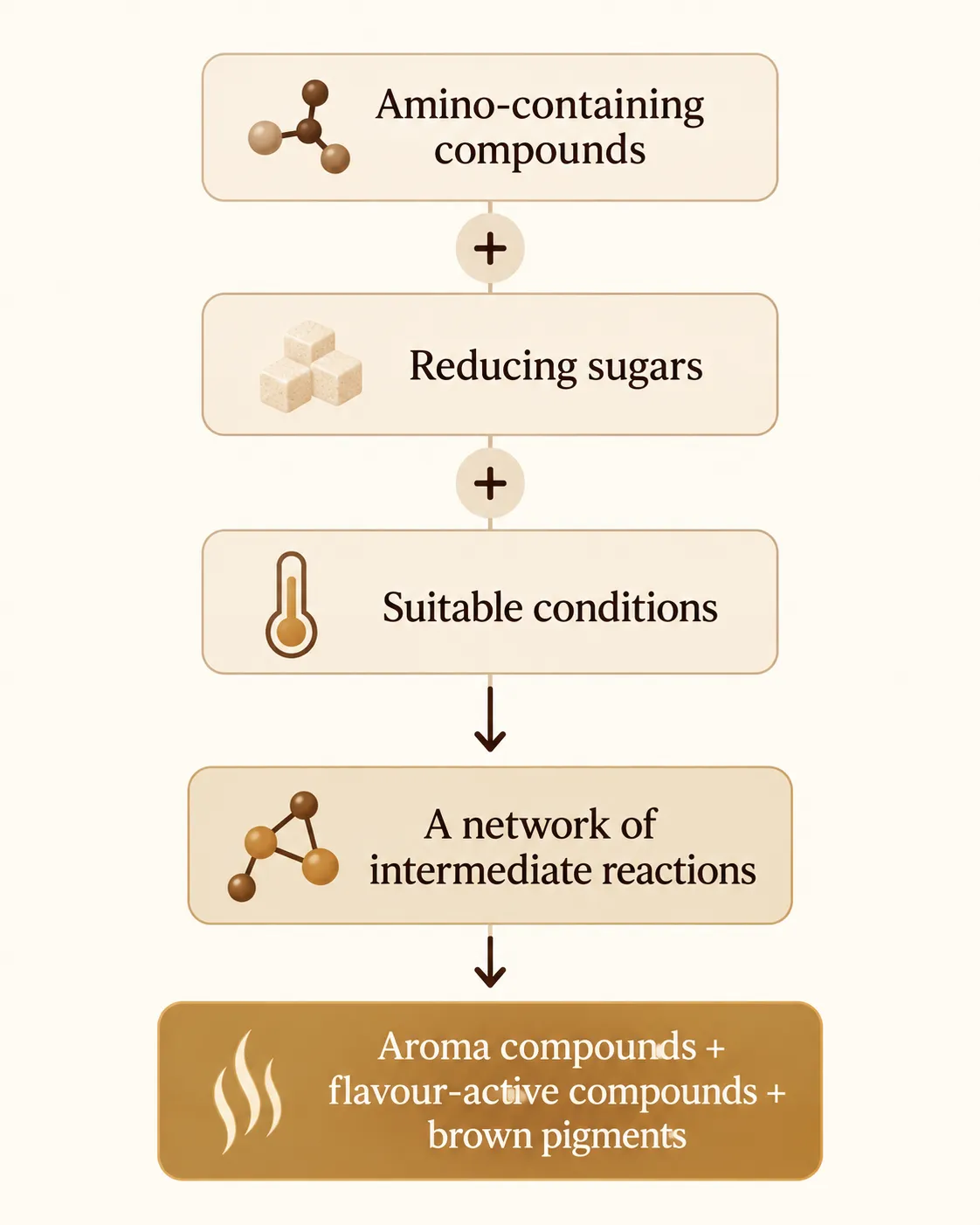
The phrase reducing sugar is important. It refers to sugars with chemistry that allows them to react in this way. Glucose, fructose, lactose and maltose are examples. Sucrose—the familiar table sugar—is not itself a reducing sugar under normal conditions, although it can be broken down into glucose and fructose under suitable conditions.
The amino side of the reaction can come from free amino acids, peptides or proteins. This is why it is slightly misleading to reduce the Maillard reaction to the popular phrase "protein plus sugar". Protein-rich foods provide plenty of amino groups, but the chemistry is more specific than that shorthand suggests.
The early stages can initially produce little obvious colour or aroma. Subsequent reactions generate numerous intermediates and eventually a wide range of compounds, including volatile aroma molecules and darker substances known collectively as melanoidins.
A comprehensive 2025 review describes the reaction in three broad stages: an early stage that produces no colour or odour, an intermediate stage that gives rise to many aroma compounds, and a final stage that forms brown melanoidins. Read the 2025 Maillard reaction review in Foods
What foods show the Maillard reaction?
The Maillard reaction appears across far more foods than the usual example of a seared steak.
You encounter Maillard chemistry in foods such as:
- the crust of toasted or baked bread;
- roasted coffee beans;
- browned or roasted meat;
- roasted nuts and seeds;
- biscuits and other baked foods;
- the browned exterior of fried or pan-cooked dumplings;
- roasted vegetables; and
- heated or toasted milk solids.
The exact compounds produced are not identical across these foods. A coffee bean contains a very different collection of sugars, amino compounds and other molecules from bread dough, a mushroom or a piece of meat. Processing time, temperature, pH and moisture also differ.
That is one reason "browned" foods do not all smell or taste alike.
A 2022 review in Food Chemistry notes that thousands of volatile flavour compounds from the Maillard reaction have been identified in food, even though the formation pathways of many are still poorly understood. Which amino compounds and sugars are present, and the conditions they are heated under, shape the aroma profile that results. Read the Maillard flavour-chemistry review in Food Chemistry
Why does Maillard browning change flavour?
The brown colour itself does not simply create the flavour. Colour, aroma and flavour develop because the underlying reaction network produces many different compounds.
Some reaction products become pigments. Others are volatile molecules that can reach your nose as you eat. Still others affect taste or interact with compounds already present in the food.
This distinction is useful because people often use visual browning as a convenient sign that flavour-producing chemistry has occurred—which is why recipes so often use colour as a doneness cue. The association is real, but colour and flavour are not the same thing.
Researchers have identified numerous classes of aroma compounds associated with Maillard chemistry. Key aroma compounds are often present only in trace amounts—between a microgram and a milligram per kilogram of food—yet still shape flavour because humans can detect them at very low concentrations. Read the study of Maillard aroma compounds
The result is not a universal "Maillard taste". Depending on the ingredients and conditions, the chemistry can contribute qualities that we perceive as roasted, toasted, nutty, savoury or otherwise characteristic of cooked food.
That is also why two foods browned to a similar colour can have completely different aromas.
Is the Maillard reaction the same as caramelisation?
No. Maillard browning and caramelisation are distinct chemical processes, although both can occur during cooking and both can create brown colours and complex flavours.
| Feature | Maillard reaction | Caramelisation |
|---|---|---|
| Main reactants | Amino-containing compounds + reducing sugars | Sugars |
| Are amino compounds involved? | Generally central to the reaction | Not required |
| Common effects | Browning plus many complex aroma and flavour compounds | Browning plus characteristic cooked-sugar aromas and flavours |
Caramelisation involves the thermal transformation and decomposition of sugars themselves. Classic research on caramelisation describes heat-driven sugar degradation leading to both brown-coloured and volatile aroma compounds. Review of caramelisation chemistry in food and beverages
In real food, however, cooking chemistry does not always stay neatly inside textbook categories. A complex food may contain proteins, amino acids, several sugars, water, fats and acids, allowing multiple reactions to occur during heating.
So "brown" does not automatically mean "Maillard", and "sweet and brown" does not automatically mean caramelisation.
Does the Maillard reaction start at 140°C?
There is no single universal temperature at which the Maillard reaction suddenly switches on.
Numbers such as 140°C (about 285°F) are often quoted in cooking explanations because rapid, visible browning becomes easier under sufficiently hot, relatively dry surface conditions. But treating one temperature as a chemical on/off switch oversimplifies what actually happens.
Reaction rate depends on the combination of temperature, time, food composition, pH and water activity. Higher temperatures generally accelerate many Maillard pathways, but Maillard chemistry can also proceed more slowly under lower-temperature conditions.
This is an important distinction between asking:
"Can Maillard reactions occur here?"
and:
"Will enough Maillard chemistry occur quickly enough to give me noticeable browning during this cooking step?"
For a home cook, the second question is usually the practical one.
Scientific reviews treat the reaction as condition-dependent: the 2025 review identifies pH, temperature, reaction time and water activity as parameters that significantly influence it, and a 2017 review of control strategies surveys ways of steering it through ingredients and processing.
Why does a wet surface brown poorly?
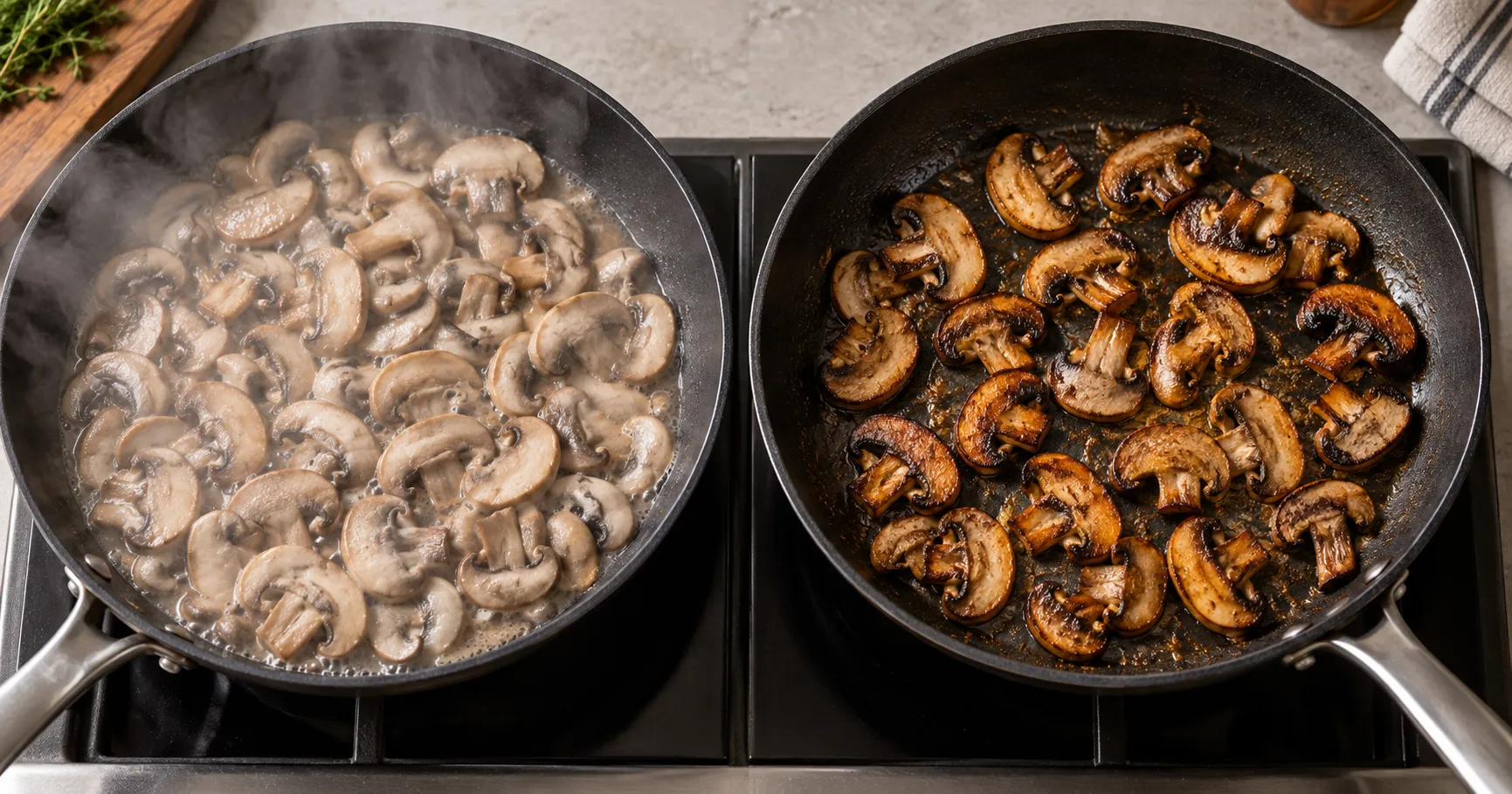
A visibly wet food surface usually makes rapid pan browning more difficult because much of the incoming heat is initially used to heat and evaporate water.
While liquid water remains on the surface, evaporation provides strong cooling. The surface therefore spends more time in conditions where rapid browning is difficult. Water also changes the concentration and mobility of the molecules participating in Maillard chemistry.
This is why several familiar cooking practices can improve browning when browning is the goal:
- Pat excess surface moisture from suitable ingredients before cooking.
- Leave enough exposed hot surface around individual pieces of food.
- Avoid severe pan overcrowding that traps moisture and promotes steaming.
- Allow steam to escape rather than continually enclosing it.
- Give the surface enough time in favourable conditions to develop colour.
There is an important scientific qualification: water is not simply "the enemy of the Maillard reaction". Researchers normally discuss water activity, not just whether a food contains water. Maillard reaction rates generally fall when water activity is very high or very low, and many food systems react fastest at moderate water activity—roughly 0.5 to 0.8 in the systems covered by the 2025 review.
For a home cook, "dry the surface" is therefore a practical instruction about rapid browning in a pan—not a claim that Maillard chemistry requires a completely water-free food.
How does pH affect Maillard browning?
Higher pH can accelerate many Maillard pathways, while more acidic conditions generally slow them.
The reason lies partly in the chemical form of the amino-containing groups involved in the reaction. Changing pH changes how much of those groups are available in a more reactive form, and it can also change which reaction pathways and flavour compounds are favoured.
The relationship is more complicated than simply "alkaline equals brown", because the food matrix, reactants, moisture and temperature still matter. But pH is important enough that food scientists deliberately manipulate it when controlling colour and flavour formation.
The 2025 review identifies pH as one of the principal variables affecting Maillard kinetics and describes faster reaction under more alkaline conditions in many studied systems.
This is the scientific basis behind some culinary techniques that use alkaline conditions to influence surface browning. It is not, however, a reason to add alkaline ingredients indiscriminately: pH also changes flavour, texture and other food chemistry.
Is more Maillard browning always better?
No. Useful browning is about control, not maximisation.
At the desirable end, Maillard chemistry contributes colour and the aromas we associate with toasted bread, roasted coffee, browned meat and many baked or roasted foods.
Push heating too far and the sensory result can move from browned to overly dark, bitter, acrid or burnt. The reaction can also modify amino acids and proteins and therefore affect nutritional quality.
Under some high-temperature food-processing conditions, Maillard-related chemistry can also contribute to the formation of compounds that food scientists try to limit, including acrylamide and several other processing contaminants. That does not mean "brown food is dangerous", nor does it justify treating all Maillard products as harmful. The chemistry produces an enormous variety of compounds, and their significance depends on the food, ingredients and processing conditions.
The useful conclusion for everyday cooking is much simpler: the objective is the degree of browning that gives the food the colour, aroma and flavour you want—not the darkest surface you can produce.
Recent scientific reviews emphasise this dual nature of Maillard chemistry: it is central to desirable sensory development but can also produce undesirable nutritional or processing effects when conditions favour them.
How can home cooks encourage useful Maillard browning?
You do not need to memorise reaction pathways to use the science. Five principles cover most everyday situations.
Manage surface moisture. Remove unnecessary water from the exterior when a browned surface is the goal. A wet surface usually has to lose that water before rapid browning can develop.
Give food enough hot exposed surface. Browning occurs where conditions are favourable. Food buried beneath other food or surrounded by released liquid receives a very different cooking environment from food in direct contact with a hot pan, where heat arrives by conduction—one of the three ways heat reaches food.
Avoid excessive crowding. Crowding can increase the amount of moisture released into a pan faster than it escapes, shifting cooking towards steaming rather than rapid surface browning.
Allow adequate time. Temperature matters, but so does duration. Moving or turning food continuously can prevent one surface from staying in favourable conditions long enough to develop the colour you want.
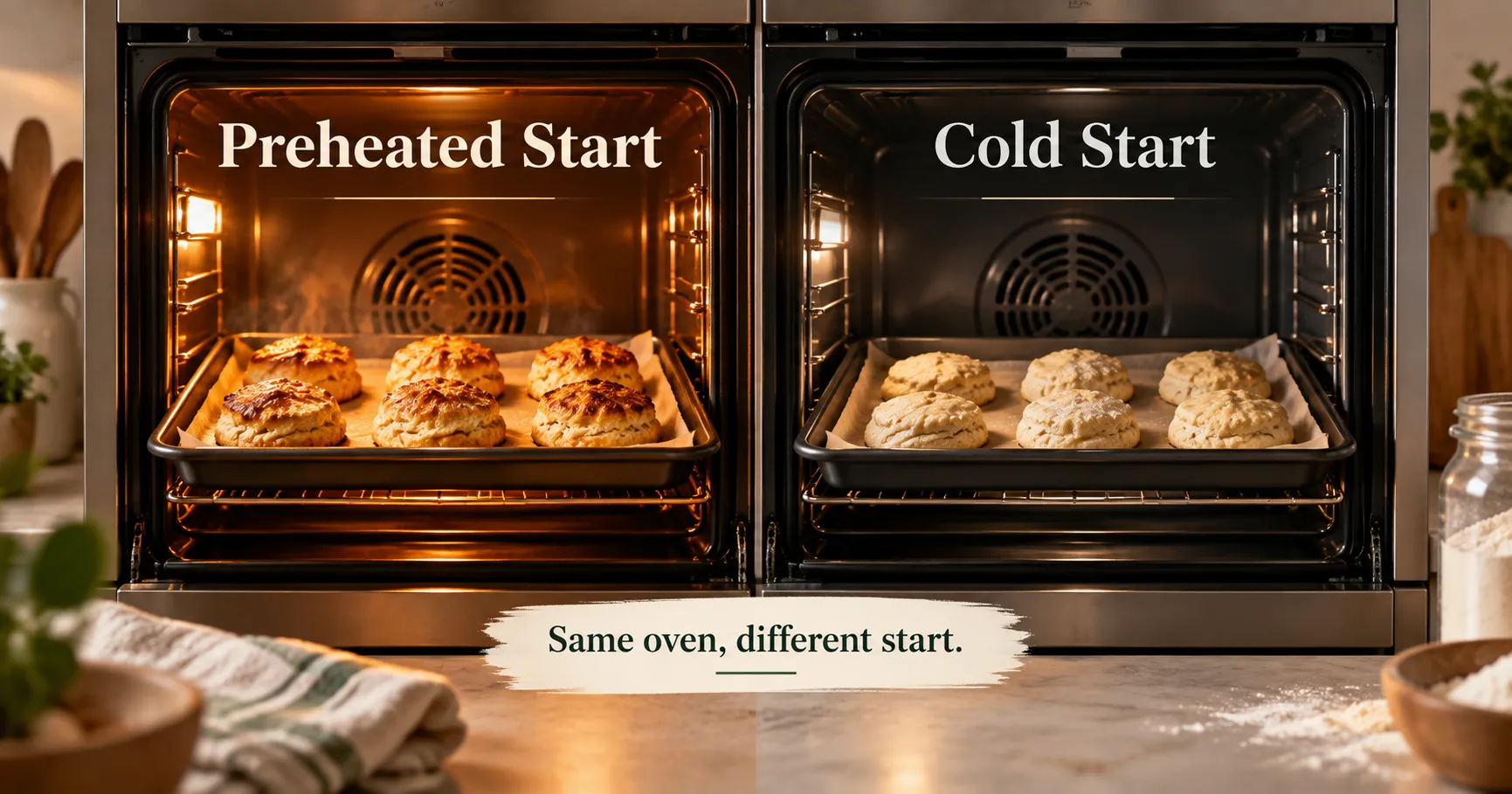
Control heat rather than simply maximising it. Very high heat is not automatically better. The aim is to develop useful browning before the exterior burns or the interior becomes overcooked. The same thinking applies to the oven: when a crust or browned surface is the goal, starting in a properly preheated oven can matter.
The larger lesson is that good browning comes from managing a system: ingredients, moisture, heat, surface contact and time all interact.
That is a more reliable way to cook than chasing a single "Maillard temperature".
The practical meaning of the Maillard reaction
The Maillard reaction explains why cooking can transform ingredients in ways that go far beyond simply making them hotter.
A pale bread crust can become deeply aromatic. Nuts develop roasted character. Coffee beans gain an extraordinary range of aroma compounds. A relatively mild raw surface can become savoury, toasted and complex after browning.
But the science also explains why the result is not automatic. The reaction depends on what molecules are available and on the conditions surrounding them. Change the moisture, temperature, time, pH or composition of the food, and you can change both how quickly browning develops and what compounds are produced.
So the most useful definition is not simply "the reaction that makes food brown."
The Maillard reaction is a condition-dependent network of reactions between amino-containing compounds and reducing sugars that can transform the colour, aroma and flavour of food.
Understanding that difference makes the concept much more useful in the kitchen.
Sources
- Control of Maillard Reactions in Foods: Strategies and Chemical Mechanisms
Review of strategies for controlling Maillard reactions and their downstream products in foods, including added ingredients, enzymes and processing approaches. Written for food science rather than home cooking.
- Maillard Reaction: Mechanism, Influencing Parameters, Advantages, Disadvantages, and Food Industrial Applications: A Review
Comprehensive review covering reaction mechanisms, temperature, time, water activity, pH, sensory effects and potentially undesirable reaction products. The pH and water-activity ranges it reports come from studied food and model systems and vary between foods.
- Maillard Reaction Chemistry in Formation of Critical Intermediates and Flavour Compounds and Their Antioxidant Properties
Review of Maillard intermediates and flavour formation. It summarises formation pathways for over 100 flavour compounds and notes that the pathways of many others remain poorly understood.
- The Aroma Side of the Maillard Reaction
Focused specifically on Maillard-derived aroma compounds and their sensory importance; not a general review of all Maillard chemistry.
- Caramelisation in Food and Beverages
Review of sugar caramelisation chemistry; used specifically to distinguish caramelisation from the Maillard reaction.