
Boiling vs Simmering vs Poaching vs Steaming: What's the Difference?
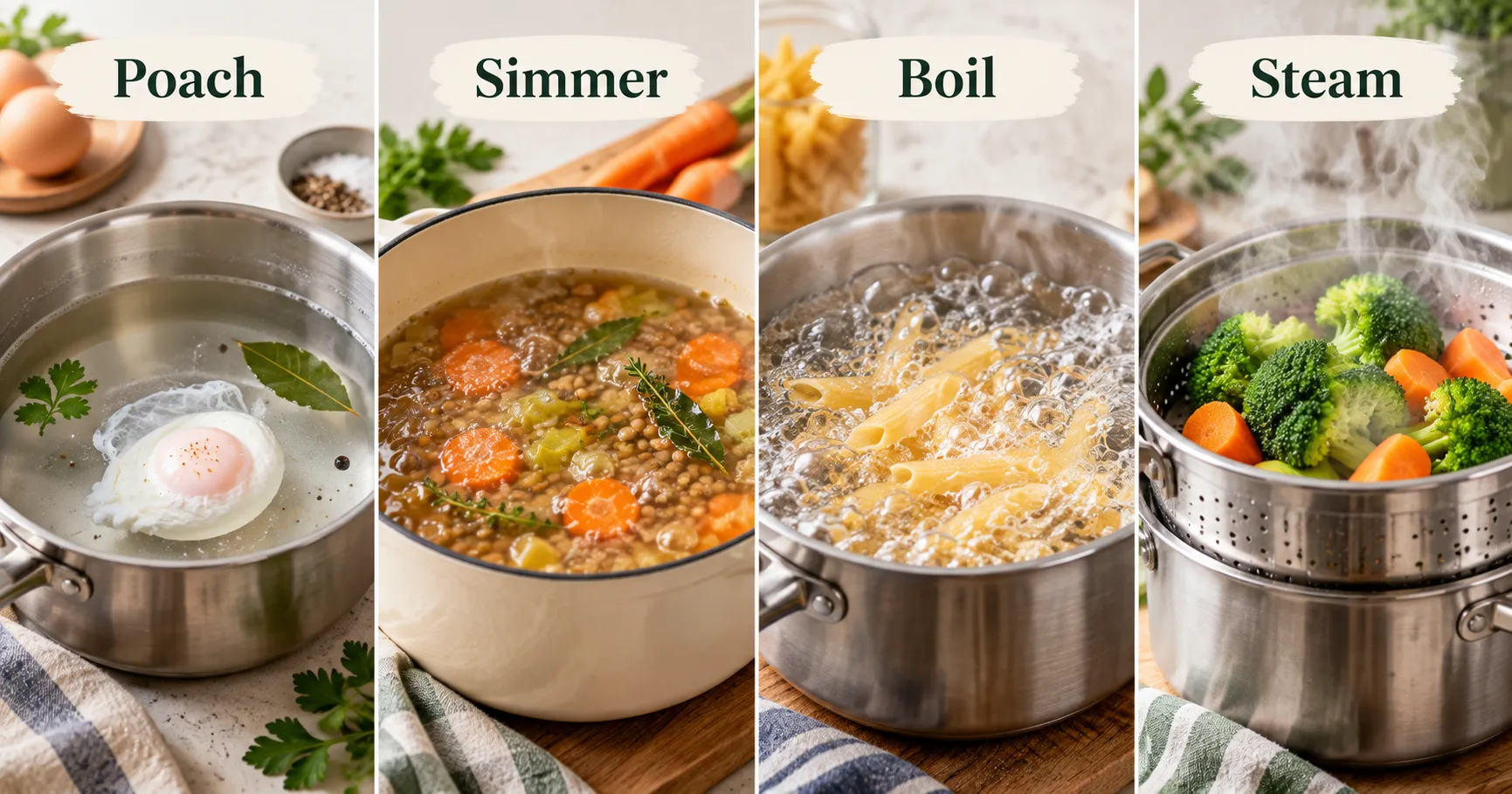
Boiling cooks food in vigorously bubbling liquid; simmering uses gentler bubbling below a full boil; poaching uses still gentler hot liquid for delicate foods; steaming cooks with water vapour rather than submerging the food. Exact temperatures vary with altitude and kitchen conditions.
Key takeaways
- Boiling uses vigorous bubbling and strong liquid movement, making it useful for foods such as pasta that can tolerate agitation.
- Simmering keeps liquid just below a full boil, with smaller, gentler bubbles suited to soups, sauces, legumes and longer cooking.
- Poaching is gentler still, with little visible movement, which helps protect delicate foods such as eggs, fish and fruit.
- Steaming keeps food out of the boiling water; heat reaches it through surrounding steam and condensation.
- Temperature ranges are useful guides, not universal rules. Altitude, atmospheric pressure, the liquid and cooking equipment can all affect what happens in the pot.
- In an ordinary kitchen, watching bubble size and liquid movement is often more useful than chasing one exact temperature.
Boiling, simmering, poaching and steaming are all moist-heat cooking methods, but they do not treat food in the same way. Each delivers heat through the same basic mechanisms: convection in the liquid or steam, and conduction into the food itself.
The most useful differences are not simply “hotter” and “cooler”. Look at four things: whether the food sits in the liquid, how vigorously that liquid moves, how much physical agitation the food experiences, and what texture you want at the end.
A pot of pasta may benefit from active boiling. A soup usually needs calmer movement. A fish fillet or poached egg may need barely moving liquid. Steamed dumplings, meanwhile, are cooked without sitting in the water at all.
University of Illinois Extension describes boiling as cooking in liquid while bubbles constantly rise to the surface, simmering as cooking just below boiling with bubbles forming slowly, and poaching as low-heat cooking in hot liquid. Read the University of Illinois Extension 4-H cooking manual
| Method | Food submerged? | What you see | Agitation | Typical uses |
|---|---|---|---|---|
| Boiling | Yes | Large, continuous bubbles breaking across the surface | Vigorous | Pasta, blanching, some grains and sturdy foods |
| Simmering | Usually | Small bubbles rising and breaking gently | Gentle | Soups, sauces, stews, legumes |
| Poaching | Usually | Very slight movement; few or no bubbles breaking the surface | Very gentle | Eggs, fish, chicken, fruit |
| Steaming | No | Steam rising around food held above the water | Little direct liquid agitation | Vegetables, dumplings, fish |
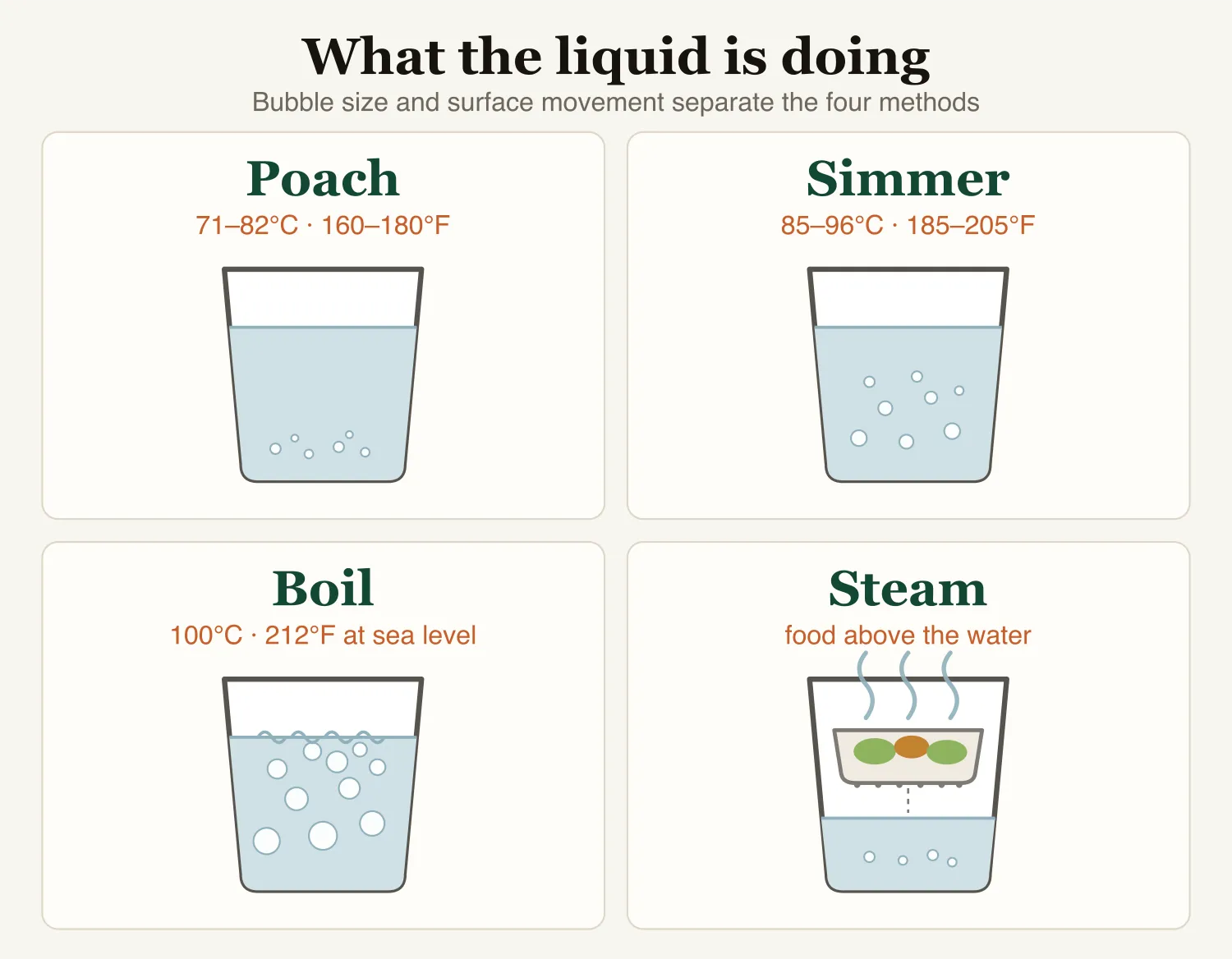
Approximate temperature guides often put poaching around 71–82°C / 160–180°F and simmering around 85–96°C / 185–205°F, while boiling occurs at the liquid's boiling point. These ranges are useful for orientation rather than as rigid kitchen rules. Utah State University Extension gives exactly these ranges alongside the matching bubble cues. Read the Utah State University Extension moist-cooking handout
What is boiling?
Boiling means cooking in liquid at its boiling point, with vapour bubbles forming throughout the liquid and breaking vigorously at the surface.
At sea level, pure water boils at roughly 100°C / 212°F, but the number is less important in daily cooking than the visual cue: a true boil is active. Large bubbles rise repeatedly, the surface moves strongly and submerged ingredients may be pushed around the pot.
That movement can be useful. Pasta, for example, is sturdy enough to tolerate active water movement, and many blanching instructions require water to return to a boil after vegetables are added. University of Minnesota Extension similarly instructs cooks to return blanching water to a boil before timing the food.
Boiling is less suitable when the ingredients are fragile or when a recipe needs slow, controlled cooking. A harder boil also does not mean the water simply keeps becoming much hotter. Once water has reached its boiling point under a given pressure, supplying additional heat mainly increases the rate of vapour formation and evaporation rather than continuously raising the liquid temperature.
What is simmering?
Simmering keeps a liquid just below a full boil, producing smaller bubbles and much gentler movement.
This is why “turn the heat to low” is not a complete definition of simmering. A particular low setting may not simmer a large stockpot at all, while a powerful burner may keep a small saucepan boiling even after being turned down.
Instead, look at the food. At a simmer, small bubbles usually rise steadily or intermittently and break gently at the surface. The liquid moves, but it should not churn as it does during a rolling boil.
That quieter environment makes simmering useful for foods that need time in liquid without excessive physical disturbance: soups, stocks, stews, dals, legumes and many sauces.
Simmering is therefore not merely a weaker version of the instruction “boil”. It is a controlled cooking state with less agitation, chosen because the movement of the liquid can affect texture as well as cooking rate.
A recipe may also use terms such as bare simmer, gentle simmer or steady simmer. These are useful descriptive cues, but they are not perfectly standardised across every cookbook.
Instructions such as “bring to the boil, then reduce to a simmer” are also a good reason to read the whole recipe before cooking: the method tells you which state the liquid should be in at each stage.
What is poaching?
Poaching cooks food in hot liquid with even less movement than simmering, making it especially useful for delicate ingredients.
The surface may appear almost still. You might see tiny bubbles forming around the bottom or sides of the pan, but vigorous bubbling is not the goal.
Common poaching foods include eggs, fish, tender poultry and fruit. The technique works well when you want heat to reach an ingredient through liquid without the physical knocking and turbulence of a boil.
The distinction between poaching and a very gentle simmer can become fuzzy in everyday recipe language. Illinois Extension, for example, describes poaching as cooking over low heat in a small amount of hot, simmering liquid, while other culinary guides separate poaching into a lower temperature band.
That variation is useful rather than inconvenient: it shows why the recipe's description of the desired liquid movement matters alongside the temperature number.
For a delicate fish fillet, “barely moving liquid” tells you more about the intended treatment than simply setting the hob to a particular number.
What is steaming?
Steaming cooks food with hot water vapour while keeping the food above, rather than submerged in, the boiling water.
A typical setup has boiling water in the bottom of a covered pot and food held above it in a basket, perforated insert or steamer tray. Steam moves around the food and transfers heat to its surface; some of that vapour condenses as it contacts the cooler food.
The physical separation from the water is the defining feature. University of Minnesota Extension specifically instructs that vegetables being steam-blanched should sit at least three inches above the water and should not touch it. Read the University of Minnesota Extension guidance on blanching vegetables
This makes steaming useful for vegetables, dumplings, fish and other foods where you want moist heat without immersing the ingredient in cooking liquid.
A lid matters because it helps keep steam around the food. You also need enough water in the lower pan to avoid boiling it dry.
Steaming is therefore not the same as boiling with less water. In boiling, the food and liquid are in direct contact. In steaming, boiling water generates the cooking environment, but the food remains physically separated from the water.
Why shouldn't cooking temperature charts be treated as universal?
Because the boiling point of water is not fixed at exactly 100°C everywhere, and culinary terms such as “gentle simmer” are practical descriptions rather than laboratory standards.
Atmospheric pressure falls as altitude increases, which lowers the temperature at which water boils. The USDA Food Safety and Inspection Service notes that water boils at about 208°F / 97.8°C at 2,000 feet, rather than 212°F / 100°C at sea level, and that boiling or simmering foods can therefore take longer at higher elevations. Read USDA guidance on high altitude cooking
This is also why simply turning the burner higher cannot make ordinary boiling water indefinitely hotter. At the same atmospheric pressure, extra heat makes boiling more vigorous and increases evaporation.
Your exact kitchen conditions matter too. Salt, sugar and other dissolved ingredients alter a liquid's properties. A thick sauce behaves differently from plain water. A covered pot behaves differently from an uncovered one. Pan shape and burner power change how clearly bubbles appear.
So a temperature chart should answer “roughly where am I?”, not “have I failed if my thermometer is two degrees different?”
For most home cooking, use this order:
- Follow the recipe's stated method.
- Observe the size and frequency of the bubbles.
- Watch how much the food is being moved around.
- Use temperature as an additional guide when precision matters.
Which cooking method should you choose?
Choose according to how much liquid contact and agitation the food can tolerate.
| You want... | Consider |
|---|---|
| Vigorous cooking in plenty of liquid | Boiling |
| Gentle, longer cooking in liquid | Simmering |
| Delicate cooking with minimal disturbance | Poaching |
| Moist-heat cooking without immersing the food | Steaming |
For pasta, boiling is usually appropriate because the food can tolerate active water movement.
For soup, dal or a slowly reducing sauce, simmering gives you more controlled movement over a longer cooking period.
For a delicate egg, fish fillet or pear, poaching reduces agitation further.
For vegetables, fish or dumplings that should remain outside the cooking water, steaming provides moist heat without immersion.
The best method is therefore not simply the hottest one. It is the method whose heat transfer, liquid contact and movement match the food you are trying to cook.
Read this way, understanding cooking methods is part of practical food literacy—the everyday judgement that lets you adapt a method rather than follow it blindly.
Is simmering the same as boiling on low heat?
No. Simmering describes what the liquid is doing, not the position of the burner control. A simmer has small, gentle bubbles and noticeably less agitation than a boil.
You may bring a liquid to the boil first and then reduce the burner until the correct simmer is established, but the final visual state is what matters.
Is poaching the same as simmering?
They overlap, but poaching is generally gentler than a standard simmer.
Poaching usually involves very little visible movement and is chosen for delicate foods. Some recipes use phrases such as “very gentle simmer” or “bare simmer” for almost the same cooking state, so follow the recipe's visual cues as well as its terminology.
Is steaming hotter than boiling?
Not necessarily. In ordinary atmospheric steaming, the water below is boiling and the steam surrounding the food is associated with that same boiling process.
What makes steaming different is mainly how the heat reaches the food: the food sits above the water rather than inside it. Pressure steamers and pressure cookers are different because increased pressure can raise the boiling temperature.
Do you need a thermometer for boiling, simmering or poaching?
Usually not for everyday cooking. Bubble behaviour is often enough to distinguish the methods.
A thermometer can be helpful when learning poaching or when a recipe specifically requires close temperature control. It should complement what you see in the pan rather than replace it.
For food safety, however, the temperature of the food itself may matter independently of whether you boiled, simmered, poached or steamed it. Follow the appropriate safe internal-temperature guidance for the ingredient you are cooking.
Sources
- 4-H Cooking 201
Educational 4-H cooking manual dated February 2015, used for its practical definitions of boiling, simmering and poaching. The terminology is written for general cooking education rather than as a precise scientific standard.
- Moist Cooking: What Method Do I Use?
Extension teaching handout giving poaching as 160–180°F and simmering as 185–205°F, with the matching bubble cues. Treat the ranges as practical guides rather than universal thresholds; the handout also labels the 212°F boiling row “Broil”, which appears to be a typographical error.
- Preserving Food at Home: Blanching Vegetables
Guidance specifically about blanching vegetables for food preservation, used here only for the physical distinction between boiling-water blanching and steaming: vegetables being steam-blanched are held at least three inches above the water and should not touch it.
- High Altitude Cooking
Continuously maintained USDA guidance (page last updated 13 August 2024) on how altitude affects water's boiling point and cooking time: water boils at about 208°F at 2,000 feet rather than 212°F at sea level, so boiled and simmered foods take longer at elevation. U.S.-specific advice.


